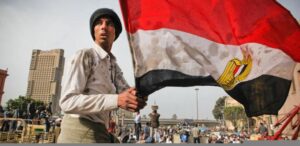
It is 25 January 2011, the day of the Police celebration in Egypt. A. D. is 17 years old and has stepped onto the streets with his uncle in Fayoum, a city very close to the capital to protest against the police, the persecution of activists, artists and all political dissidents. However, protests in the country were brutally repressed: Muhammad Moshni Mubarak‘s regime was extreme and very violent and protesting was not counted among the constitutional rights, at least in practice.
Three days later, on 28 January, police stations and prisons were empty: the officers stopped working as a sign of protest and all detainees were released. It is chaos. All of Egypt poured into the streets the following month: “That day was the moment we decided to go to the square and not come back until Mubarak resigned,” A.D. tells The Bottom Up. Tahrir Square in Cairo is the centre of the revolution, crowded with millions of people. “It was in the midst of all those people that I finally felt I could breathe, talk about politics and my rights,” A.D. says. After 18 days of protest, President Mubarak resigns: it is the end of a 30-year dictatorship.
Post-revolution Egypt
Post-revolution Egypt was a cosmopolitan place that also attracted thousands of people from abroad. Everyone wanted to participate in this historic moment when Egyptians could finally say their thoughts without going to jail. In June 2012, the first democratic elections were held in modern Egypt, and Mohamed Morsi, leader of the Muslim Brotherhood, the most organised political group in Egypt, won.
From this moment on, A.D. starts to be socially active: he participates in various initiatives in his neighbourhood and volunteers with Salmeya (from Arabic, “peace”), a networking group with activists, lawyers, politicians and artists to implement projects for social change in Egypt. With them, he talks about the right to vote, the right to choose, and the value of being human. He creates a space to understand each one’s differences and divergences and accept the variety that, during Mubarak, did not exist. A.D. then also joins a theatre group where he attends workshops that allow him to do what he wants: to share what he is, what he thinks and writes, at a time when there is still freedom to think and criticise in Egypt. A few months later, A. D. takes the stage as a dancer and actor for the first time. What he does is generally known as street theatre, but it is properly called social theatre because it deals with specific societal problems. This moment of freedom, however, does not last long. The democratically elected government is gradually overthrown and a new regime is established, headed by a little-known general who looks so much like Mubarak: Abdel Fattah al-Sisi. It is 3 July 2013.
A. D’s first show, which took place in Al Menya, a city in southern Egypt known for violent clashes between Christians and Muslims, was interrupted after 30 minutes by some police officers on the charge of “despising religion”. The play dealt with religion and stereotypes and Christian actors and actresses used sarcasm to make the audience understand the complexity of the subject. “With irony and confrontation, we depicted what happens there,” explains A.D., namely that Christians are a persecuted minority and not recognised as having equal rights to the rest of the Muslim population.
Besides social theatre, A.D. is also involved in “art therapy for social change”, workshops that work on groups of people, from children to adults, to improve their lives and discuss social and political issues. It works like this: civil rights associations identify problems in segments of the population and regions, for example, disproportionate violence against women, they then contact the theatre company to do a workshop with the perpetrators of such violence. “We deal with the people nobody wanted to deal with,” explains A.D. “But they also suffer violence, horribly. We must not see them as inhuman beings who have no right to the right”.
But the political situation began to change, the dictatorship intensified and the police began to repress all forms of peaceful dissent and to stifle civic space, the right to freedom of expression, association and peaceful assembly, reducing the spaces where A. D. and his comrades can work. As stated in an Amnesty International report, thousands of critics and opponents of the government, real or alleged, have been arbitrarily detained and/or unjustly prosecuted. Egyptian police and national security agency agents arbitrarily arrest lesbian, gay, bisexual and transgender people and detain them in inhuman conditions, systematically mistreat them, torture them and incite fellow detainees to abuse them. One of A. D.’s friends, Sarah Hegazy, was arrested and tortured for raising a rainbow flag at a punk concert in Cairo: it was the first time someone had shown the flag of the LGBTQIA+ community. Once released, she emigrated to Canada, where she committed suicide a few months later: she could not bear what had happened to her.
In 2014, A. D.’s theatre company came under government scrutiny and four years later he staged what would be one of his last shows: doing theatre had become too dangerous. In 2018, an actor from his company was arrested as soon as he landed at Cairo airport, after having spent months in Europe. Before being released, he disappeared for 11 days, where he was tortured and beaten. Together with him, Shady Habashy, a filmmaker, and Gal A Bheiry, a poet, were also arrested for political dissent: they had written a song and shot a music video about the revolution. Shady died in prison in 2020 due to a lack of treatment and health problems, while Gal Al is still in prison.
To read the article in Italian: Egitto, il teatro sociale come atto di resistenza politica