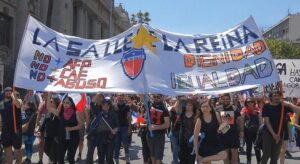
“I was insulted, tailed and offered ‘helicopter rides’, a reference to the way they used to throw disappeared prisoners into the sea during the Chilean dictatorship”. Maria Rivera, a Chilean lawyer and activist, described the climate in Chile during the Estallido Social, the social demonstrations that broke out in 2019 and continued during the COVID-19 pandemic. During this period, police persecution of protesters and activists was on the agenda, and Rivera, who works to defend those suffering violence from the state and police, was an easy target.
What began on 18 October 2019 as a student protest against the increase in the price of metro tickets was joined by millions of citizens who protested against the privatisation of the pension system, the improvement of public education and the public health system, and access to decent housing. The government responded to these demands with war.
Maria Rivera is one of the survivors of Augusto Pinochet‘s dictatorship. In 1980, at the age of 32, she was kidnapped and taken to the Borgoño barracks, one of the largest torture and detention centres in the country. She remained there for three years before being exiled to Argentina. Pinochet’s dictatorship lasted 17 years, from 1972 to the early 1990s, as the military junta crushed opposition. Rivera could only return to Chile seven years later, in 1990, when the dictatorship ended.
According to Rivera, the actions of the police during the Estallido were the same as during the dictatorship: physical tortures, forced naked exposures, verbal humiliations, threats and rapes. During the dictatorship, beatings, harassment and kidnappings by plainclothes police were commonplace. It was also common “to detain people for hours without informing them or their families, and to deny lawyers access to police stations”.
According to Amnesty International’s analysis of the strategy of the national police (Carabineros) to prevent demonstrations in 2019, the disproportionate use of force was constant and daily.
Persecution, arbitrary arrests and use of weapons
Rivera is one of the founders of Defensa Popular, a non-profit organisation that provides legal defence to anyone who turns to it. These are usually people who have suffered violence at the hands of the police. During the Estallido Social, Defensa Popular defended many defendants who had suffered different kinds of violence and had been imprisoned. Rivera remembers the cases of Mauricio Cheuque and Claudio Villagra Silva.
Cheuque is a 36-year-old worker of Mapuche origin who lives in Santiago. In 2019, when the protests were already burning in the capital, he was hit by two police cars on his way home, breaking his hip. It was no accident; Rivera has seen the police use the same method on other occasions during protests. At the police station, Cheuque was physically and verbally harassed because of his origins. In Chile, racism against indigenous people is common among right-wingers and gendarmes. The worker was accused of having Molotov cocktails in his bag, but after 13 months in prison, Cheuque was acquitted for lack of evidence.
Claudio Villagra Silva, on the other hand, is a 60-year-old man who spent 330 days in pre-trial detention. He had gone to the police station with his wife to arrange a visit to their son, who had been arrested during the social unrest. Claudio Villagra Silva, who suffers from an illness that prevents him from standing properly, lost his balance and fell to the ground. The guards at the police station jumped on him, kicked him and took him into custody on charges of assaulting a police officer and trying to steal a rifle from him. The younger inmates called him “El tata”, the grandfather, and helped him move around because he was unstable and dizzy. No one could believe the charges against him, not even the prosecutor, who decided not to acquit him for lack of evidence.
Lethal weapons and sexual abuses
“Demonstrations in Chile inevitably involve violence, as they always have,” comments Rivera. Tear gas and water are not used by the security forces to disperse protesters but as real weapons. In 2019, however, the violence was on a different scale for two reasons: the involvement of the military and the use of lethal weapons.
As soon as news of the mass subway protests broke, then-president Sebastián Piñera declared a state of emergency, which led to a military curfew on the streets. Within days, officers were equipped with riot control rifles loaded with multiple kinetic impact ammunition. The bullets, as explained on page 20 of Amnesty’s report, are made of rubber and metal alloy and cause high levels of damage as they penetrate the skin and disperse when fired. They do not meet international standards on the use of force and are considered lethal. These munitions were fired by officers directly into the chests and faces of protesters, the report says. The number of people who died from the impact of the bullets was 31, while 347 suffered eye trauma, also as a result of the misuse of tear gas.
In addition to the misuse of weapons, the security forces also sexually abused the protesters, according to international law. “Sexual violence is one of the torture methods left over from the dictatorship,” said Maria Riviera, “it’s one of the most damaging, degrading and terrible that exists. It takes years to overcome this kind of trauma, which is designed to destroy any possibility or awareness of confronting power. According to the Amnesty International report, there are 246 victims of sexual violence. Josué Maureira Ramírez is one of them.
Maureira Ramírez, a 24-year-old medical student, was stopped by police in a supermarket in Santiago. In the vehicle, the officers verbally harassed him, alluding to his sexual orientation, then pulled down his trousers and made comments about the size of his genitals. Josué was also kicked in the face. The abuse continued when they arrived at the police station: the officers took advantage of a blind spot, where the security cameras could not record, to sexually assault him. Later, two other officers, accompanied by the two officers who had arrested him, allegedly took him to a part of the police station where they forced him to bend over while holding his arms, pulled down his trousers and inserted a retractable baton into his anus. During the rape, the two officers who had previously assaulted him cursed and used degrading language such as “Look at this faggot bastard, do you like it in the hole”? The rapes took place in police stations, police vans and, if confirmed, in the Baquetano metro in Santiago, which is used as an intelligence and torture centre.
Call to arms
The repeated and disproportionate use of force was a government-backed police policy, not isolated actions by individual officers. This policy saw violations of physical integrity as a necessary evil to restore ‘public order’, punish demonstrators and end protests at all costs. The rhetoric that the Carabineros are at war with subversives is a common narrative of right-wing politics and police institutions since the Pinochet dictatorship. It serves to justify the violence of agents. In the context of the Estallido Social, this narrative was reinforced by the words of President Sebastián Piñera, who publicly declared two days after the riots began that he was “at war with disorder and destruction”. According to Amnesty’s report, this view was used to justify the use of the State Security Law, which is particularly reminiscent of the regime of General Augusto Pinochet. This law violates the principle of legality and provides for a disproportionate and unjustified use of the criminal law to punish behaviour related to protests. The police institution and the government that used it applied principles used in war, such as ‘collateral damage’. The people who died and those who lost their eyesight are collateral damage to the government.
As the Amnesty International report shows, the abuses were not only permitted but sanctioned by the Director General, Mario Rozas, the highest authority in the police force. This was evident, the report says, in a leaked recording stating that no officer would be dismissed, regardless of his or her conduct, and in the minimal number of sanctions imposed compared to the number of complaints received. Such sanctions do not even occur in cases where the official has admitted responsibility or in cases of possible cover-ups.
The Head of State and other government officials are accused of violating Article 5 of Law 20357, which covers crimes against humanity, genocide and war crimes. The Chilean courts have filed and accepted three complaints for possible crimes under international criminal law.
To read the article in Italian: Il Cile ha un problema con le violenze della polizia