In December 2023, Chileans were asked to vote on a new constitution written by right-wing parties after the failure of the 2022 referendum, which proposed a constitution written by the left. The result was no different, however, and the new constitution was rejected by 56 per cent. Interviewed by The Bottom Up, Vicente Rodriguez, a Chilean international relations student at the University of Padova, and Maria Rivera, a Chilean lawyer and activist, said the draft is a step backwards. “It is worse than the current constitution, the one from the Pinochet era. The text talks about land confiscation from Indigenous people, and there are no references to reforms in education, pensions or law enforcement,” says Rivera. The constitution proposed by the right-wing parties seeks to strengthen the right to private property, and free market principles and further restrict the right to abortion, which is still illegal except in special cases, and immigration. Jennifer Piscopo, a professor of gender and politics at the University of London, told Al Jazeera that the problem for Chileans was that “the proposed constitution does not address the demands for greater social equality and economic opportunity that sparked the constitutional process”. The draft included tougher laws on crime and immigration, and an attempt to restrict women’s rights and LGBTQ+ rights.
The failure of the 2022 referendum
The 2023 Constitution was conceived after the failure of the 2022 Constitution, which was proposed by left-wing parties and rejected by the Chilean people with 61.9 percent of the vote. The new charter contained some interesting proposals, such as free education, trade union freedom and the right to abortion. But for Rivera, all these rights would remain on paper, since the state lacks the economic means to guarantee them and turn them into concrete actions.
According to Vicente Rodriguez, the main reason for the rejection of the constitution was “the smear campaign financed by the mainstream political parties”. Among the various reports that were spread was the idea that once the new charter was approved, “the state would take away our homes, or we would no longer be able to choose which school to send our children to”.
The project for a new constitutional charter was launched after a first referendum in October 2020, in which 78 per cent of Chileans voted in favour of a new constitution. “The constitutional process works like a ‘political kitchen’, it’s a tug of political negotiations between parties,” explained Rivera, who participated in the roundtable to draft the proposed 2022 constitution. Although the working group had different political currents, Rivera added that they all seemed to agree not to engage in real reforms. “The disagreements that existed were on matters of form and not of substance, they did not define the future of the country, they were on secondary issues.”
Estallido Social: the origins of the 2020 referendum
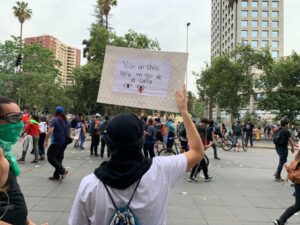
The 2020 referendum was a result of the Estallido Social, a series of protests and social uprisings across Chile in 2019-2020. The demonstrations began on Friday 18 October 2019, when high school students in Santiago, the capital of Chile, entered metro stations en masse without paying for tickets. The students had been protesting by jumping the metro turnstiles for four days since the price of tickets had been raised by 30 pesos (about 3 cents). The police were waiting for them, lined up and ready to fire tear gas into the crowd. The demonstration turned violent: 20 stations were vandalised and set on fire, buses stopped running and the Enel office was torched. The protests spread across the country. The Chilean president at the time, Sebastián Piñera, declared a state of emergency, imposed a six-month curfew and mobilised the army in Santiago.
President Piñera spoke of war and coup plotters intent on destroying ”an oasis of peace and tranquillity in Latin America.” However, the demonstrators were calling for an end to the exploitative system that began with Augusto Pinochet‘s dictatorship. “This was a revolution,” said Maria Rivera. “The demands raised in the mass uprising could not be resolved without a change in the capitalist system”. For the first time, the rich and ruling class are beginning to fear losing their power and wealth. But this fear lasts only a few moments: soon there is a return to authoritarian rule.
The next day, Saturday 19 October, shopping centres and supermarkets across the country were stormed. People used the goods to build barricades. More than a million citizens took to the streets of Chile to demand better living conditions. Starting with rising transport costs, the demands extended to the pension system, public education and health care, and access to decent housing.
Segregation in education
The demonstrations were attended by different sectors of the population: students, workers, and pensioners. Vicente Rodriguez was in Chile in 2019, joining the demonstrations to demand reform of the education and pension systems.
“Education in Chile is based on segregation: the gap between public and private education is abysmal,” explained Rodriguez, who taught philosophy at a private high school in 2019. “The only way to get a proper education,” he continued, “is to pay, and the more you pay, the more education you get,” Rodriguez explained that this system, however, creates a vicious circle in which only those who can afford to pay for private schools and universities have access to better jobs and housing, can afford better health insurance, have a decent retirement, and can provide certain opportunities for their sons and daughters.
The fact that schools and universities are private means that they function as an industry that can flourish or fail, and even generate fraud. “The case of many students who choose private universities is that they have to abandon their studies because the university fails, perhaps after going into debt to the state to pay the fees,” Maria Rivera pointed out. “There are people who are still in debt to pay for their studies, and many of them have had their homes repossessed for this reason,” the lawyer continued.
The pension system
Chile’s pension system is completely private. Each citizen can choose the company that manages his or her pension, the Administradora de Fondos de Pensiones. Ten per cent of the income goes to these private funds, which use it to buy shares. So people’s money is used to make more money through investments in private funds. You can lose pension money and increase it. In the case of Rodríguez’s parents, their pension was reduced and “those who have worked without a regular contract for most of their lives live on just 130 euros a month”, says Vicente Rodríguez.
The system‘s inability to provide adequate outcomes for a large segment of participants worsens as demographic trends and low global interest rates continue to reduce replacement rates. In addition, recent legislation allowing the withdrawal of retirement savings to counter the effects of the COVID-19 pandemic further reduces replacement rates and increases fiscal costs.
Health care and liberalism
Chile’s healthcare system is a mix of public and private. Until the 1980s, it was predominantly public, both in terms of funding and care delivery, with a private sector to which wealthier citizens turned. Everything changed with the coup that brought Augusto Pinochet to power. The new president implemented liberal policies in all civil society’s sectors, including health. Insurance and private services were encouraged. As a result, to access health care, people now have to choose between the public system, FONASA (Fondo Nacional de Salud), or the private system, ISAPRE (Institucion de Salud Previsional). The latter is a private institution that finances health services, and to access it you have to pay at least 7 per cent of your salary, so you need a regular employment contract. ISAPRE has access to a network of private hospitals and offers different health plans based on an assessment of income, age and health status. FONASA, the public system, has similar access conditions, but with reduced benefits due to lower funding and therefore much more limited in terms of quality and waiting times. For example, Maria Rivera said, “There are situations where people die waiting in line at the hospital. Not literally, but it happens that they give an appointment for a medical operation on the 15th of November and the person dies in the meantime.” At the same time, the difference between the two systems is not limited to the quality of services: with FONASA, 7 per cent of your salary is equivalent to full health coverage, while with ISAPRE you only have access to a basic package. “In general, choosing private insurance means spending at least twice as much as with the public system,” explains Vicente Rodriguez.
To read the article in Italian: Dall’Estallido Social ai referendum costituzionali: in Cile le riforme le decidono i cittadini